

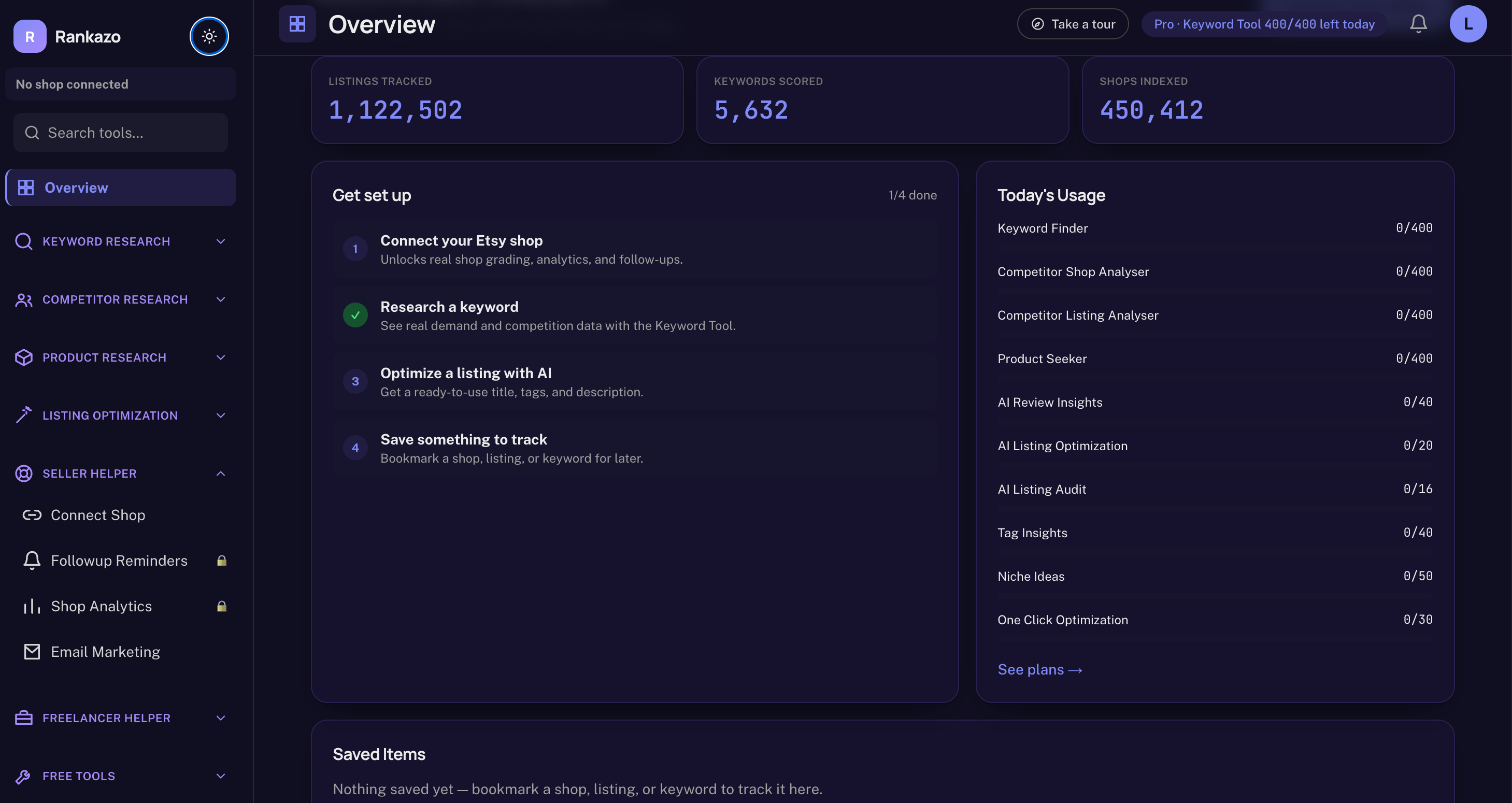
For years, before I could do proper Etsy SEO, I had to do everything else first. Competitor analysis. Niche research. Positioning. Product research. All of it manual, all of it slow, and SEO was always the last step, not the first.
I tried tool after tool to speed this up, and every one of them failed me in one of two ways.
Some made me do all the real work myself. The tool gave me a place to look, but the actual thinking, is this niche worth entering, is this gap real, was entirely on me. Others did the opposite. They handed me numbers with nothing underneath them. Demand, competition, two figures, and I was supposed to make a real business decision from that. But real research needs more, demand quality, not just demand size, how deep that demand actually goes, how much of it I could realistically capture. And competition isn’t one thing, it’s several gaps hiding under one word, a product gap, a customer gap, an offer gap, and which one is actually open changes whether a market is worth entering at all.
Skip that and you’re not deciding anything. You’re guessing.
So I stopped looking for the right tool and built my own. Something that automated the niche research, competitor research, and market research I was already doing manually, and did keyword research at a level deeper than demand and competition alone.
I built it for myself first. Then I started using it with clients. Then a few people asked if they could use it too.
That’s how Rankazo became a real product, quietly, before I ever wrote a word about it here.
I’ve spent the last several months writing about one idea over and over, that most people fail on Etsy not from lack of effort, but from guessing instead of following a system. This tool is where that idea actually came from. It’s the system I built for myself before I could ever write about needing one.
It’s live now at Rankazo.com, and it already has real users. I haven’t talked about it here until now, mostly because I wanted this account to be about the writing first. But it’s part of the same work, so it’s time to actually introduce it properly.
More on how it works, and how I use it myself, in the coming weeks.